NYK Line of Japan has joined hands with seven organisations in the country to build a technology that can measure greenhouse gas (GHG) emissions of ships from a distance without touching them.
The agreement for the same was signed on November 25, 2026, and Yokohama Port will be the main site for the trials. The initiative has been named True Emission Eye Maritime and aims to measure, visualise and quantify the emissions coming out of vessels.
Banking major MUFG Bank and Nagoya Electric Works are among the partners, as are ArkEdge Space and construction firm Shimizu Corporation.
The City of Yokohama, along with two corporations that run port facilities in the city, has also signed the deal.
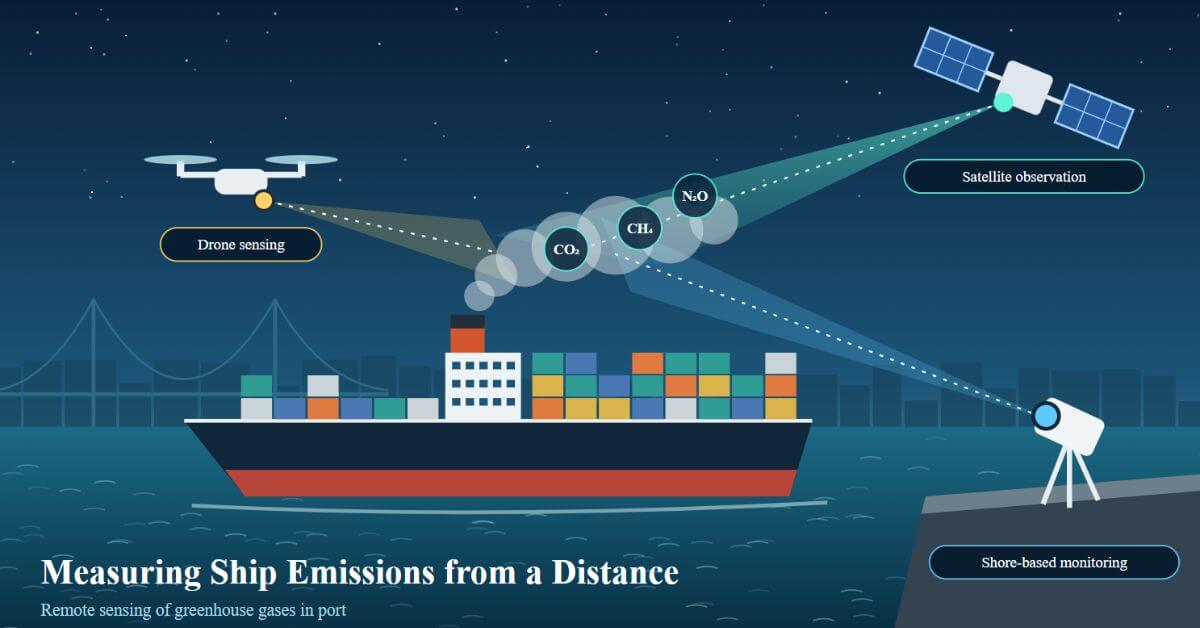
The team also plans to use drones alongside satellites to cover wider ocean areas. This plan is mainly due to the shipping industry facing stricter emission rules from global regulators.
Usually, the emissions of a ship are worked out on paper from the type of fuel it burns and how much of it is consumed. The new system will instead look directly at the exhaust from outside the ship, thereby adding a direct measurement to the existing method.
It works on the principle that gases like carbon dioxide absorb and give off light at certain wavelengths which optical sensors can pick up. Readings from the exhaust are then put together with the distance to the ship and the weather at the time to work out how much it emits.
Trials have so far been done at test facilities and on vessels of the NYK Group, both while berthed and at sea.
At Yokohama Port, the team captured infrared images of ship exhaust from spots like a pier and the skywalk of the Yokohama Bay Bridge, which are now being matched against vessel data. More measurements in varied conditions will follow to sharpen the accuracy, while fixed monitoring points at ports are also being looked at.
The partners will also study what it will take to track ship emissions from satellites and how such data could be merged with readings from the ground.
The eight members hope to put the technology into real use, which could make vessel emissions reporting more transparent for shipping and port operators.
Republished from Marine Insight.
View the original at Marine Insight →Source: Marine Insight
Image: Henryk Bielamowicz, CC BY-SA 4.0, via Wikimedia Commons (Ustka, port morski (HB2).jpg)
Industry News
Get the headlines that matter
Shipping, maritime, and oil and gas news curated daily by the MarineCraft News Desk, with Malaysian and Southeast Asian developments front and centre.
We use your address only to send Industry News. Unsubscribe any time. See our Privacy Policy.