Marine and offshore operations present some of the highest-risk industrial environments globally. Personnel operate in remote waters, harsh weather conditions, hydrocarbon processing zones, and heavy industrial settings where emergency response time is limited. In these environments, lifesaving equipment is not an accessory — it is a critical survival system.
Marine and offshore operations present some of the highest-risk industrial environments globally. Personnel operate in remote waters, harsh weather conditions, hydrocarbon processing zones, and heavy industrial settings where emergency response time is limited. In these environments, lifesaving equipment is not an accessory — it is a critical survival system.
When fire, explosion, flooding, structural failure, or collision occurs, survival depends on the readiness and reliability of:
- Lifeboats and survival craft
- Liferafts
- Immersion suits
- Lifejackets
- Emergency signaling devices
Operators who treat lifesaving equipment as a strategic risk management system — rather than a compliance obligation — consistently achieve better safety outcomes and reduced detention risk.
SOLAS & IMO Requirements for Lifesaving Equipment
All international marine vessels are governed by the International Maritime Organization (IMO).
The primary legal framework is the SOLAS (Safety of Life at Sea Convention), specifically Chapter III covering Life-Saving Appliances.
Under SOLAS, vessels must:
- Provide survival craft capacity for 100% of persons onboard
- Ensure equipment is Type Approved under the International Life-Saving Appliance Code
- Maintain regular inspection and servicing schedules
- Conduct routine abandon-ship drills
- Ensure embarkation arrangements remain clear and functional
Failure to comply can result in Port State Control detention, commercial delays, insurance implications, and reputational damage.
Types of Lifesaving Equipment Required on Ships & Offshore Installations
1. Lifeboats (Totally Enclosed & Free-Fall)
Lifeboats are primary survival craft designed to protect personnel during abandonment.
Totally enclosed motor-propelled survival craft (TEMPSC):
- Provide fire protection and weather shielding
- Include independent propulsion systems
- Are self-righting in capsize scenarios
- Contain emergency rations, first aid kits, and signaling equipment
Free-fall lifeboats are commonly installed on offshore platforms due to:
- Rapid launch capability
- Reduced mechanical dependency
- Improved survivability in hydrocarbon fire environments
Routine inspection of release hooks, davit wires, and engines is critical. Improper maintenance of release systems remains one of the most common causes of PSC deficiencies.
2. Marine Liferafts
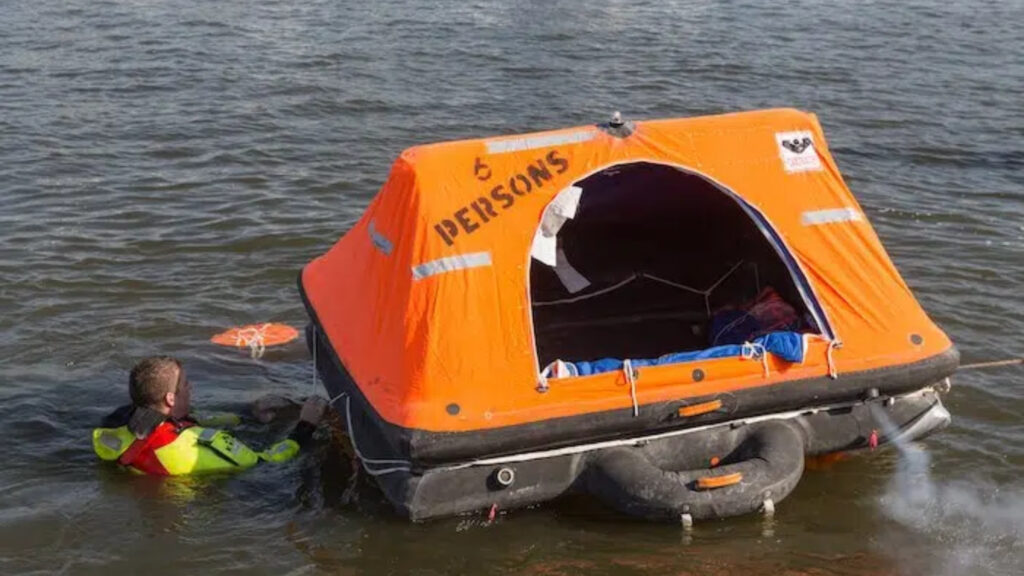
Liferafts provide supplementary or primary evacuation capacity.
SOLAS liferafts:
- Inflate automatically upon water contact
- Include insulated flooring and canopy protection
- Contain survival packs with water, rations, and signaling equipment
- Are released automatically via Hydrostatic Release Units (HRU)
Servicing is mandatory at approved stations annually or as specified by flag requirements.
Expired HRUs and improperly secured liferafts are common causes of vessel detention.
3. Immersion Suits & Thermal Protective Aids
Immersion suits are essential in cold-water operations where hypothermia can occur within minutes.
They:
- Reduce heat loss
- Provide buoyancy
- Protect against cold shock
- Extend survival time significantly
Proper sizing, storage, and periodic leak testing are critical to maintaining performance integrity.
4. Lifejackets & Personal Flotation Devices
SOLAS-approved lifejackets must:
- Provide minimum 150N buoyancy for adults
- Turn unconscious wearers face-up
- Include retro-reflective tape
- Incorporate self-igniting lights and whistles
Inflatable lifejackets require careful inspection of gas cartridges and activation mechanisms.
For offshore high-risk operations, AIS-enabled personal locator devices are increasingly adopted to enhance search and rescue speed.
5. Emergency Signaling & Distress Equipment
Effective rescue depends on rapid detection.
Key systems include:
EPIRB (Emergency Position Indicating Radio Beacon)
Transmits 406 MHz distress signals via satellite networks, providing GPS location to rescue coordination centers.
SART (Search and Rescue Transponder)
Responds to radar signals, assisting rescue vessels in final approach.
Pyrotechnic Signals
Include rocket parachute flares, hand flares, and buoyant smoke signals. These must be stored correctly and replaced before expiry.
All distress systems integrate within the GMDSS framework.
Inspection & Maintenance of Lifesaving Equipment
SOLAS Regulation 20 mandates structured inspection regimes.
Operators should implement:
- Daily visual checks for accessibility and damage
- Weekly lifeboat engine test runs
- Monthly release gear and davit inspections
- Annual servicing by approved service stations
- 5-year load testing and overhaul
Common deficiencies identified during Port State Control include:
- Expired pyrotechnics
- Corroded lifeboat wires
- Inoperative release hooks
- Missing retro-reflective markings
- Crew unfamiliarity with equipment operation
A proactive Planned Maintenance System (PMS) significantly reduces compliance risk.
Risk-Based Selection of Offshore Survival Equipment
Equipment selection should align with operational environment.
Cold-water regions require enhanced immersion suits and insulated survival craft.
Hydrocarbon platforms may justify installation of free-fall lifeboats for rapid evacuation during fire events.
High POB (Persons On Board) installations should apply redundancy planning beyond minimum compliance.
Procurement decisions must consider lifecycle cost, service station availability, and spare part logistics — not just capital price.
Training & Crew Competency
Under the STCW Convention, personnel must complete certified survival training.
Offshore personnel typically undergo:
- Basic Offshore Safety Induction & Emergency Training (BOSIET)
- Helicopter Underwater Escape Training (HUET)
- Emergency Response Team training
Regular drills reinforce muscle memory and reduce panic-induced delays.
Well-trained crews can compensate for complexity; poorly trained crews magnify risk.
Lessons from Major Offshore Incidents
Historical incidents such as the Piper Alpha disaster and the Deepwater Horizon explosion reshaped evacuation standards globally.
Key lessons include:
- Importance of redundant evacuation systems
- Fire-protected escape routes
- Strong emergency leadership
- Regular drills under realistic conditions
Compliance alone does not guarantee survivability — preparedness does.
Final Thoughts: Lifesaving Equipment Is Strategic Risk Infrastructure
For marine and offshore operators, lifesaving equipment is not merely regulatory compliance — it is strategic life-preservation infrastructure.
Operational excellence requires:
- Strict compliance with SOLAS & LSA Code
- Structured inspection regimes
- Risk-based equipment selection
- Continuous crew training
- Strong emergency leadership
In offshore and marine environments, survival is engineered long before an emergency occurs.
Frequently Asked Questions (FAQ)
1) What is lifesaving equipment in marine and offshore operations?
Lifesaving equipment refers to the approved appliances and systems used to protect personnel during emergencies at sea, including lifejackets, immersion suits, lifebuoys, liferafts, lifeboats (including TEMPSC/free-fall types), and distress alerting devices like EPIRBs and SARTs.
2) What regulations govern lifesaving equipment on ships?
International requirements are primarily governed by SOLAS (Safety of Life at Sea) and the IMO’s LSA Code, with additional flag-state rules and verification through class societies and Port State Control inspections.
3) What is the difference between the SOLAS LSA Code and SOLAS Chapter III?
SOLAS Chapter III sets the mandatory “what must be carried and arranged.” The LSA Code sets the detailed “how it must perform,” including technical specifications and testing requirements for each type of lifesaving appliance.
4) How do offshore lifesaving requirements differ from standard vessels?
Offshore installations and drilling units often require enhanced evacuation capability due to higher fire/explosion risk and remoteness, commonly using free-fall lifeboats (TEMPSC), additional redundancy, and offshore-specific emergency response arrangements.
5) What is a TEMPSC lifeboat?
TEMPSC stands for Totally Enclosed Motor Propelled Survival Craft. It’s a fully enclosed lifeboat designed to protect occupants from fire, smoke, and harsh weather, and to navigate away from danger zones under its own propulsion.
6) What is the difference between free-fall lifeboats and davit-launched lifeboats?
Free-fall lifeboats launch by sliding down a ramp and entering the water quickly with fewer mechanical dependencies. Davit-launched lifeboats rely on davits, wires, and winches to lower the boat—effective but more dependent on mechanical condition and operational space.
7) What is an HRU (Hydrostatic Release Unit) and why is it important?
An HRU releases a liferaft automatically if a vessel sinks, allowing the raft to float free and inflate. Expired or incorrect HRUs are common Port State Control findings and can prevent auto-deployment.
8) How often should liferafts be serviced?
Liferafts must be serviced at approved service stations according to flag/class requirements (commonly annually or at specified intervals). Servicing includes inflation testing, inspection, repacking, and certification.
9) What’s the difference between an EPIRB and a SART?
An EPIRB sends a distress alert via satellite networks to rescue coordination centers with location data. A SART helps rescuers during final approach by responding to radar signals and making survival craft easier to locate.
10) What are the most common Port State Control deficiencies related to lifesaving equipment?
Typical deficiencies include expired pyrotechnics, expired HRUs, corroded davit wires, faulty lifeboat release gear, missing markings/retro-reflective tape, blocked access to survival craft, and crew unfamiliarity with launching procedures.
11) What should a planned maintenance program (PMS) include for lifesaving equipment?
A robust PMS should track serial numbers, expiry dates, service certificates, weekly/monthly operational checks, annual servicing records, and 5-year load tests—so everything is audit-ready for ISM, class, and PSC inspections.
12) How can operators improve survival readiness beyond compliance?
Beyond compliance, operators should focus on realistic drills, role clarity at muster, redundancy planning, risk-based equipment upgrades for the operating environment, and using only approved service providers with strong documentation control.